

Here’s a question I ask every business owner who tells me they’re thinking about selling: what does your life cost per year? Most give me a confident answer. Almost all of them are wrong — and wrong in the same direction, by the same mechanism. They’re quoting what their household spends out of their personal checking account. They’re not counting what the business has been quietly spending on their behalf for the last twenty years.
The family health insurance premium. The truck and the SUV — payments, insurance, fuel, tires. The cell phones, the home internet, the laptop refresh. The conference in Scottsdale that was also a vacation. The client dinners. The spouse on payroll. The life and disability premiums. The dues, the subscriptions, the season tickets with a client’s name attached. Individually, each one is a legitimate business expense and a rounding error. Together, they are a second paycheck — one that never shows up on your W-2, never hits your bank account, and never makes it into your mental math about what your lifestyle costs.
Adding Up the Invisible Paycheck
Run the exercise honestly for a typical owner household and the number is startling. In the illustrative example below, the business is absorbing $87,000 a year of what is, functionally, personal lifestyle cost. I’ve seen it lower. I’ve seen it well north of $100,000. I have almost never seen an owner who had already counted it.
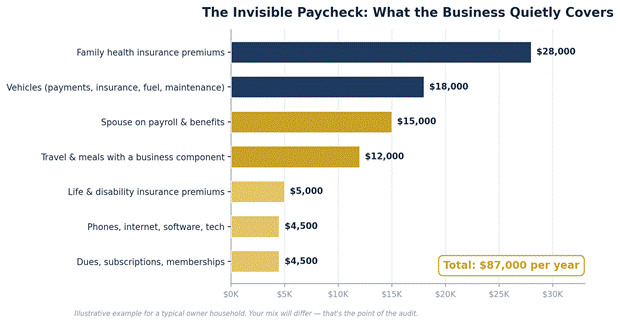
The single biggest line deserves special attention: health insurance. If you sell before age 65, you are buying family coverage on the open market until Medicare — and for a couple in their late fifties, that can run $2,000 to $3,000 a month for coverage that’s worse than what the company plan provided. It is routinely the largest and least anticipated new expense in an owner’s post-sale budget.
The Cruel Irony: Your Add-Backs Become Your Bills
Here’s the part that makes this problem so easy to miss. When you sell, your M&A advisor will comb through the financials looking for exactly these expenses — and add them back to earnings. Owner perks inflate adjusted EBITDA, adjusted EBITDA drives the multiple, and the multiple drives your price. Every professional in the deal is motivated to find these expenses, celebrate them, and use them to make your company look more profitable. Nobody in the deal is motivated to point out the flip side: the day after closing, every one of those add-backs becomes a personal bill. The same $87,000 that just added several hundred thousand dollars to your purchase price is now $87,000 of new annual spending, forever.
Why a Small Miss Becomes a Seven-Figure Miss
If this were just an $87,000 budgeting oversight, it would sting but not wound. The problem is that retirement income doesn’t work that way. Sustainable spending has to be funded by capital — and at a sustainable withdrawal rate of roughly 4%, every dollar of annual spending requires about twenty-five dollars of portfolio behind it. Underestimate your lifestyle by $87,000 a year, and you haven’t made an $87,000 mistake. You’ve made a $2.2 million mistake.

This is how an owner ends up believing a $5 million net sale funds their life comfortably, when the honest math says it’s tight — or short. And it compounds with a problem I’ve written about separately: the gap between a headline purchase price and actual after-tax, in-hand proceeds. Overstate what you’ll receive and understate what you’ll spend, and the two errors stack. I’ve watched that combination quietly turn a “more than enough” exit into a spending problem within five years.
The Fix: A True Lifestyle Audit, Years Before You Sell
The solution isn’t complicated, but it has to happen early. Two to three years before you go to market, run a true lifestyle audit: go through the company financials line by line and flag every expense that would migrate to your personal budget if the business disappeared tomorrow. Price each one at retail — what it will actually cost you to replace, not what the company pays. Health insurance gets quoted on the open market. Vehicles get priced with payments and insurance in your name. Then rebuild your retirement plan on the honest number.
Done early, this exercise pays you twice. First, your “number” — the price and terms you actually need from a sale — becomes real instead of hopeful, which changes how you negotiate and whether you accept the first credible offer. Second, you get time to act on what you learn: cleaning up owner perks a few years before a sale makes your books easier to diligence, and in some cases restructuring how you take compensation can improve both your sale story and your tax picture.
This analysis lives squarely in the blind spot between your CPA, who categorizes the expenses, and your M&A advisor, who adds them back. It’s the job of a fiduciary planner — someone whose only stake is whether your life is actually funded after the wire clears. I work for you, not a commission. And the first thing I’d want to know, long before anyone talks about multiples, is what your life really costs.
Clearstone Wealth Management is a fee-only, fiduciary registered investment advisor. This article is for educational purposes and is not individualized tax, legal, or investment advice. Figures shown are illustrative; consult your CPA regarding the treatment of specific business expenses.