

The phantom net proceeds problem — and why no one at your closing table is paid to explain it to you.
Ask a business owner what their company is worth and they’ll give you a number. Ask them what they’ll actually be able to spend after they sell it, and most will give you the same number. That gap — between the headline purchase price and the money that actually lands in your account, when it lands — is what I call the phantom net proceeds problem. It is the single most common surprise I see in owner exits, and it’s almost never discussed until it’s too late to do anything about it.
Here’s the uncomfortable part: nobody in your transaction is being paid to close that gap for you. Your M&A advisor is compensated on the headline price — the bigger the top-line number, the bigger their fee. Your attorney is paid to get the deal signed. Your buyer certainly isn’t going to volunteer the math. Every professional at the table has done their job well, and you can still walk away with less than half of what you thought you sold for.
The Anatomy of a Disappearing Purchase Price
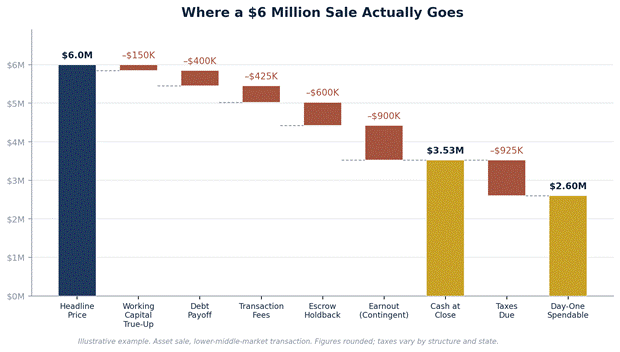
Let’s walk through a realistic example: a healthy lower-middle-market business that sells for a headline price of $6 million. Before you ever see a wire, the deal itself takes several bites.
The working capital true-up. Nearly every purchase agreement requires you to leave a “normal” level of working capital in the business — receivables, inventory, operating cash. If the peg is set against your strongest quarters, you’ll owe the difference at close. Owners routinely think of that cash as theirs. Contractually, it isn’t. Call it $150,000.
Debt rides ahead of you. The equipment loan, the line of credit, the SBA note — all of it is paid off at close, before you. Another $400,000.
The professionals get paid at closing. Investment banking success fees, legal fees, quality-of-earnings work. On a deal this size, $425,000 is not unusual — and worth every penny if they’ve run a real process. But it comes out of your number.
The escrow holdback. Buyers typically hold back around 10% of the price — here, $600,000 — in escrow for 12 to 18 months to cover indemnity claims. You may get most of it back. You may not. Either way, you can’t spend it at close.
The earnout. If $900,000 of your price is contingent on the business hitting targets over the next two or three years — under someone else’s management — that money is a hope, not an asset. Industry experience says earnouts are partially paid far more often than fully paid.
You’ve now gone from $6 million to roughly $3.5 million in actual cash at close — and the IRS hasn’t shown up yet. Depending on your deal structure (asset versus stock sale), your state, and how much of the price gets taxed as ordinary income through depreciation recapture, the tax bill on those closing proceeds can easily run $900,000 or more. Day one, your spendable wire is about $2.6 million. Not $6 million.
The Second Problem: When the Money Shows Up
The waterfall above is only half the story. The other half is timing. Your retirement plan doesn’t run on a purchase price — it runs on cash flow. And the cash from a business sale arrives in installments, on someone else’s schedule.
The escrow, if it comes back clean, arrives a year or more after close — often reduced by claims you’ll have limited practical ability to fight. The earnout pays out over two to three years, if it pays at all, based on performance targets you no longer control. In the realistic scenario below — 80% of escrow returned, 60% of earnout targets hit — our $6 million seller ultimately collects about $3.4 million after tax, spread over three years.
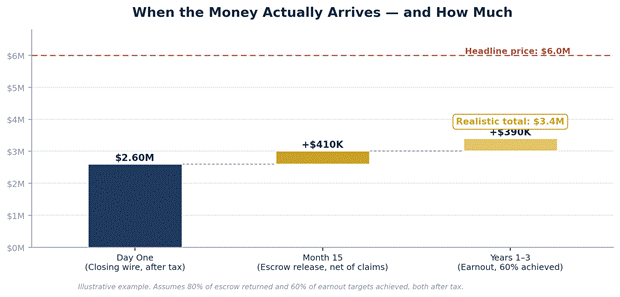
Now consider what happens if that seller built their retirement plan — their spending, their home purchase, their gifting to kids, their sense of “I made it” — on the $6 million figure. They haven’t just miscalculated. They’ve made irreversible life decisions against money that was never really theirs.
Why You Won’t Hear This Before the LOI
This isn’t a story about bad actors. It’s a story about incentives and sequencing. The net proceeds waterfall lives in the cracks between three professionals: the M&A advisor models enterprise value, the CPA calculates the tax bill after the structure is chosen, and the financial planner — if there is one — usually gets handed the proceeds after the wire hits. By then, every decision that determined the size and timing of that wire has already been made.
The moment of maximum leverage is before you sign the letter of intent. That’s when deal structure, working capital pegs, escrow percentages, and earnout terms are still negotiable — and when a $200,000 improvement in terms costs you nothing but foresight. After exclusivity is signed, leverage flips to the buyer, and it never flips back.
What I Tell Owners to Do
Build your personal net proceeds waterfall before you go to market — not after. Model the deal from headline price down to after-tax, in-hand dollars, by date. Stress-test it: what does your retirement look like if the earnout pays zero? If the escrow comes back at half? If the number that comes out of that exercise still funds the life you want, you can negotiate from strength and sleep at night. If it doesn’t, you’ve just learned — while there’s still time to act — that you need a better price, better terms, or a few more years of building value.
This is exactly the kind of analysis a fiduciary advisor should be doing for you, because we’re the only ones at the table whose compensation doesn’t depend on the deal closing. At Clearstone, we work for you, not a commission — and in an exit, that distinction is worth real money. The M&A advisor’s job is to maximize the price. Our job is to make sure the price actually becomes your retirement.
Clearstone Wealth Management is a fee-only, fiduciary registered investment advisor. This article is for educational purposes and is not individualized tax, legal, or investment advice. Figures shown are illustrative; consult your CPA and attorney regarding your specific transaction.